

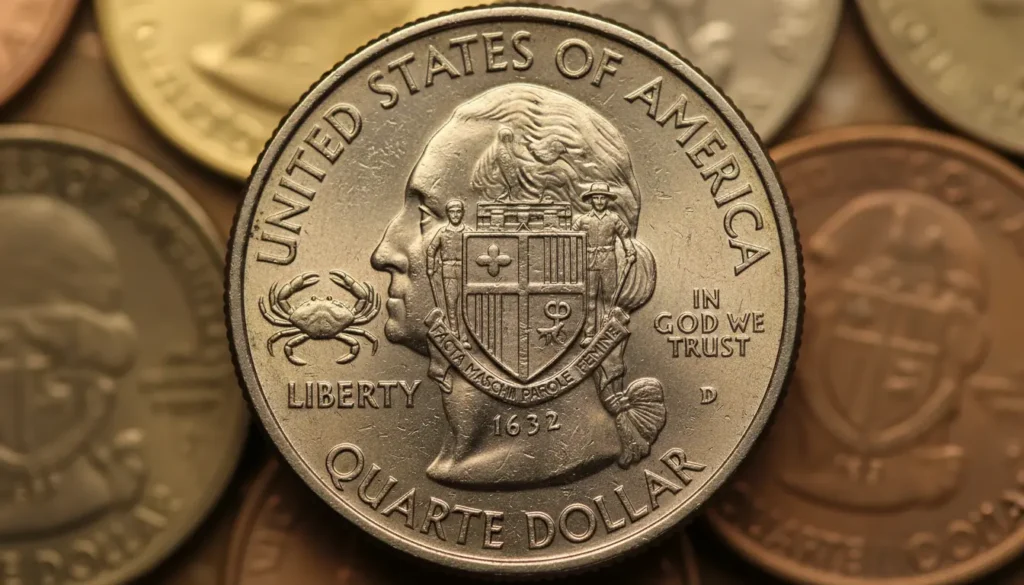
Why state quarter coins can be worth money
State quarter coins were produced in huge numbers between 1999 and 2008, but not every coin is common in collectible condition. Errors, special proof strikes, and low-surviving-population pieces can be far more valuable than face value.
Knowing what to look for and how to document a find will help you decide whether a quarter is worth checking with a dealer or grading service.
5 most valuable state quarter coins to watch
This list focuses on five categories of state quarter coins that most often command higher prices. Each entry explains what makes the variety collectible and how to identify it.
1. Wisconsin Extra Leaf Varieties (2004)
The Wisconsin state quarter has one of the most famous collectible varieties: the “extra leaf” on the corn stalk. Two main varieties exist, commonly called “high leaf” and “low leaf.”
High-grade examples, especially uncirculated or certified pieces, can be sought by collectors because the error is visually distinct and scarce.
- How to ID: Look at the left corn stalk near the top; extra small leaf shapes appear above the ear of corn.
- Tip: Use a magnifier and bright light. Variety guides or comparison photos help confirm which leaf variety you have.
2. Doubled Die State Quarter Coins
Doubled die errors occur at the hubbing stage and cause clear doubling of letters or designs. On state quarter coins, doubling on the date, motto, or state name is most noticeable.
Doubled dies can range from subtle to very pronounced. The more obvious the doubling and the higher the grade, the more likely the coin will attract premium prices.
- How to ID: Check lettering and numerals for doubled edges under magnification.
- Example: Doubling on the date or the word UNITED can often be spotted with a 10x loupe.
3. Off-Center and Misstrike State Quarter Coins
Off-center strikes and other misstrikes happen when the planchet is not centered under the dies. The result is a partial design or dramatic blank areas on one side.
These pieces are popular with error-coin collectors and can carry significant premiums based on how far off-center and how much of the design is visible.
- How to ID: Look for incomplete rims, missing letters, or parts of the design cut off.
- Tip: Even a small off-center strike may be collectible; larger offsets usually increase interest and value.
4. Proof and Silver State Quarter Coins
Proof state quarters struck in special sets or made on silver blanks are often worth more than circulation strikes. Proofs have sharper details and mirror-like fields that collectors prefer.
Silver proofs were sold in mint sets and are typically marked by their finish and packaging. These coins are graded and sold to collectors with a focus on condition.
- How to ID: Proof coins show sharp detail and a mirrored background. Silver pieces weigh slightly more than copper-clad quarters.
- Tip: Keep proof coins in their original packaging to preserve value.
5. Rare Mint Errors and Low-Surviving-Population Varieties
Some state quarters survive in far fewer numbers due to production quirks or because a specific error was caught early. These low-survival varieties can be among the most valuable.
Examples include rare die cracks, missing mint marks, or unusual planchet compositions. The scarcity and condition of these coins determine collector interest.
- How to ID: Research the specific state issue and compare with reference photos from reputable numismatic sites.
- Tip: When in doubt, photograph both sides and seek an expert opinion before selling or cleaning.
How to check and document a potentially valuable state quarter coin
Discovering a coin you think might be valuable is exciting, but correct documentation matters. A few steps will help you preserve value and show authenticity.
- Do not clean the coin. Cleaning can dramatically reduce a coin’s value.
- Photograph both sides with good lighting and a magnifier for close-ups of the area of interest.
- Compare images with reputable references such as major numismatic publications and error-coin databases.
- Consider getting the coin graded by a professional service if you believe it has significant value.
Case study: Finding an extra-leaf Wisconsin quarter
A collector in the Midwest found a Wisconsin quarter in pocket change that showed a tiny extra leaf on the corn stalk. The collector photographed the coin and compared it to online guides before contacting a local coin dealer.
The dealer confirmed the extra-leaf variety and suggested sending the coin for third-party grading. After verification, the coin attracted interest from collectors who pay premiums for certified examples.
Lesson: Careful documentation and using trusted experts greatly improves chances of realizing value.
Where to sell or get value for state quarter coins
Options include local coin dealers, online auction platforms, coin shows, and professional grading services. Each route has pros and cons related to fees, speed, and exposure to buyers.
If a coin is potentially valuable, obtaining a professional grade and a clear provenance often results in better sale prices and more buyer confidence.
Final practical tips for collectors
- Always handle coins by the edges to avoid fingerprints.
- Store possible valuable coins in protective holders and avoid cleaning.
- Use trusted resources and dealers for grading and sale advice.
- Keep a record of where and when you found the coin — that can help with provenance.
State quarter coins can surprise you. Even common series have pockets of rarity, so take a closer look the next time you find a quarter in your pocket or drawer.