

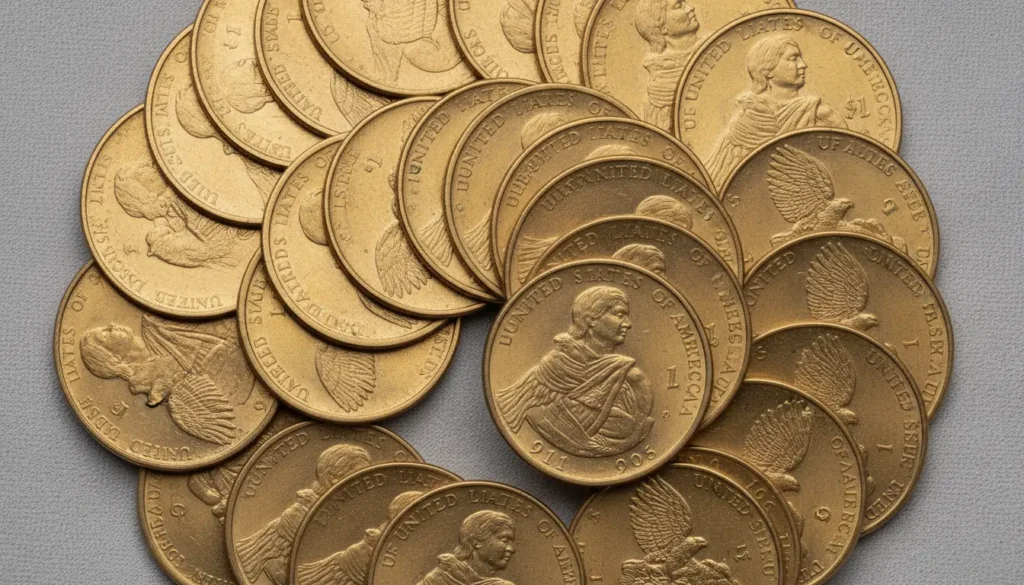
How to Read This Guide on Rare 2009 Sacagawea Dollar Errors
This guide explains the rare error types seen on 2009 Sacagawea dollars and gives practical tips for identifying and valuing them. Each section focuses on a specific error, what to look for, and why it matters to collectors.
Why 2009 Sacagawea Dollar Errors Matter
The U.S. Mint issued multiple Sacagawea reverse designs in 2009 as part of the Native American $1 Coin Program. The production of different dies and increased striking volume created opportunities for several kinds of errors. Collectors favor clear, dramatic errors that are easily authenticated and well documented.
Common Rare 2009 Sacagawea Dollar Errors to Look For
Below are the most collectible error categories seen on 2009 Sacagawea dollars. Each entry describes what to inspect and how to document a find.
Off-Center Strikes
An off-center strike occurs when the die does not align with the planchet. These can be partial strikes showing a portion of the design cut off by a smooth edge. Larger offsets are more desirable.
- Look for a flat, smooth rim on one side where the metal did not receive the full design.
- Photograph obverse and reverse with scale for documentation.
Die Cracks, Cuds, and Raised Lines
Die cracks and cuds form when the die develops a fracture or metal builds up on the die face. These appear as raised lines or blobs of metal on the coin’s surface.
- Minor hairline cracks are common; focus on large, consistent cuds that alter the portrait or reverse motif.
- Use magnification to determine whether marks are on the die or later damage.
Double Strikes and Doubled Die
Double striking happens when a coin is struck more than once; doubled die varieties come from a misaligned hub during die creation. Both can produce doubled letters, dates, or design elements.
- Check lettering on the obverse for doubling under magnification.
- Document orientation—double strikes often show rotated or ghost images.
Planchet Errors and Clad Layer Exposures
Planchet errors include clipped planchets, wrong planchets, and lamination where the outer layer peels exposing underlying material. Because Sacagawea dollars are manganese-brass clad over a copper core, exposed layers can be visually striking.
- Look for silver-colored inner core or missing outer brass that reveals copper tones.
- Laminations often appear as flaking; determine if the error is mint origin or post-mint damage.
Broadstrikes and Collar Errors
A broadstrike occurs when the retaining collar does not hold the planchet, producing a coin with a wider diameter and no defined rim. These are dramatic and collectible if the strike is otherwise sharp.
How to Authenticate and Grade 2009 Sacagawea Error Coins
Authentication separates true mint errors from damage or alteration. Use these steps to evaluate a suspect coin.
- Examine under 10x–30x magnification to find hub doubling, die chatter, or die markers.
- Compare to verified photos from reputable references and auction records.
- When in doubt, send the coin to a third-party grading service (PCGS, NGC) for attribution and encapsulation.
Value Factors for 2009 Sacagawea Dollar Errors
Several elements determine value: rarity, eye appeal, severity of the error, and certification. Many dramatic errors that are clearly mint-made and in above-average condition command premiums.
- Large off-center strikes and full broadstrikes typically rate higher.
- Minor die cracks have modest premiums unless unusual or large.
- Certification by a reputable service greatly increases market acceptance and price.
Practical Tips for Collectors
When searching through pocket change or rolls, concentrate on strong visual anomalies. Carry a loupe, small flashlight, and a phone camera for quick documentation.
- Always note mint mark and year clearly in photos.
- Save coins in clear flips and avoid cleaning them, which can destroy value.
Small Case Study: Finding an Off-Center 2009 Sacagawea
A hobbyist searching through a box lot found a 2009 Sacagawea with a roughly 30 percent off-center strike. They took detailed photos, compared the coin to online references, and submitted it to a grading service for attribution.
After certification, the coin sold in a specialized auction for a multiple of face value. The key factors were the clear mint origin of the error and professional certification.
Where to Buy, Sell, and Learn More
Good sources for error coins include certified auction houses, specialized error coin dealers, and reputable online marketplaces that allow returns and third-party verification. Join collector forums and error-coin groups to learn current trends and to find reference photographs.
Final Checklist for Identifying Rare 2009 Sacagawea Dollar Errors
- Is the error dramatic and consistent with a mint-origin flaw?
- Do multiple views show the same feature without signs of post-mint damage?
- Have you compared the coin to verified references or sought third-party grading?
Using this checklist helps separate promising finds from common damages. Careful documentation and certification will maximize the coin’s collectible value.